




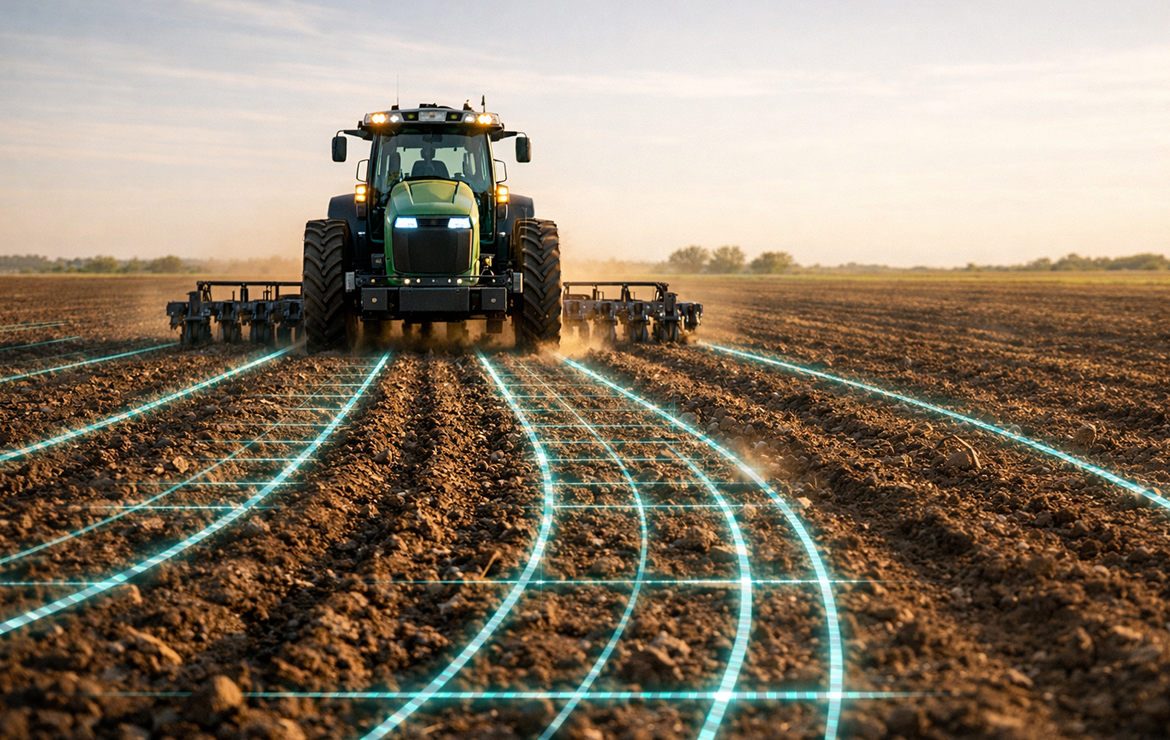
How AI in Agriculture Is Enabling Smarter, More Sustainable Farming
By 2050, we’ll need to feed nearly 10 billion people with less water and changing weather patterns. The answer might not come from finding more land, but from making our farms smarter. Farmers are now getting a powerful new assistant that can see every plant and predict the future to help build a more sustainable world: Artificial Intelligence.
This new approach is at the heart of what is known as precision agriculture. Simply put, it means treating each plant or small section of a field precisely as needed, rather than applying the same amount of water or fertilizer everywhere. It’s the essential difference in smart farming vs. traditional farming—moving from a blanket approach to targeted, individual care, powered by sustainable agriculture technology.
Consider a farmer’s 100-acre cornfield. In the past, they might have sprayed the entire area to manage a few weeds. With precision farming, a tractor’s AI-powered camera spots and targets only the weeds. This targeted approach can drastically reduce herbicide use, saving farmers money and protecting the environment from unnecessary chemicals.
Giving the Farm Digital Eyes and Ears
To treat a field with precision, a farmer must first know what’s happening plant by plant. Modern farming accomplishes this with digital ‘eyes and ears.’ Flying high above the crops, agricultural drones act as the farm’s eyes in the sky. They are equipped with special cameras that can see far more than the human eye, capturing detailed images that reveal the hidden health of the entire field at once.
From these images, a simple but powerful “health map” is created. This map works like a traffic light, coloring healthy areas of the field green, struggling areas yellow, and problem spots red. This allows a farmer to instantly pinpoint issues like pest infestations or irrigation leaks that would have been impossible to find just by walking the rows. It’s a complete check-up for the entire farm, done in minutes.
At the same time, tiny sensors pushed into the dirt act as the farm’s ears, listening to the soil. These devices constantly measure crucial information, like how much water is available to the plant’s roots. Together, the eyes in the sky and the ears in the ground gather an enormous amount of information. But this vast amount of data needs a brain to make sense of it all.
How AI Acts as the Farm's Super-Brain
Sifting through all the information from drones and sensors would be overwhelming for any person. This is where Artificial Intelligence (AI) comes in, acting as the farm’s central super-brain. AI takes millions of data points and, much like a human brain, instantly finds patterns to understand crop health. This is the core of modern AI in agriculture.
Instead of complex spreadsheets, the AI translates data into simple, actionable advice. For example, it might connect a dry soil reading with a rainless forecast and send an alert: “The northeast corner of your field needs watering tomorrow.” This process turns overwhelming data into a helpful to-do list, highlighting the practical benefits of AI for everyday decision-making.
But the real magic happens when this digital brain connects directly to the farm’s tools. The AI can tell an irrigation system exactly where and how much to water, or guide a machine to act on a specific problem. This level of intelligence is now powering a new generation of agricultural robots, changing how we protect our crops with incredible precision.
Putting AI to Work: Robots That Reduce Chemical Use by 90%
This intelligent connection is powering a new generation of agricultural robotics. Instead of blanketing a field with chemicals to fight weeds, these machines see and think, acting with the precision of a gardener tending to each plant.
The key is an AI skill that works like our sense of sight, often called computer vision. Just as your brain can instantly tell the difference between a rose and a dandelion, this AI has been trained on millions of images to distinguish between a healthy crop and an unwanted weed in a fraction of a second.
As these smart machines move through the field, their AI-powered cameras scan the ground in real-time. The moment the AI spots a weed, it directs a small nozzle to spray just that single plant, leaving the valuable crop and the surrounding soil completely untouched. This is a powerful example of AI solutions for pest detection.
The results are revolutionary, reducing overall herbicide use by up to 90%. This is one of the most significant advantages of AI in agriculture, meaning far fewer chemicals contaminate our farmland and environment.
Predicting the Future to Prevent Waste and Hunger
AI’s power extends beyond reacting to problems; it can also prevent them through predictive analytics. Think of it as a super-powered forecast for the farm itself. By analyzing years of weather data, soil conditions, and satellite images, AI can predict problems like a disease outbreak before the first plant even shows a symptom. This gives farmers a crucial head start, allowing them to act preventatively instead of just reacting to a crisis.
This predictive power also helps answer a farmer’s most important question: “How much food will I grow?” AI-powered crop yield prediction provides a reliable harvest estimate months in advance. This allows farmers to secure buyers and plan transportation, dramatically reducing food waste from logistical delays.
On a global scale, these predictions are even more powerful. When governments and aid organizations can accurately forecast harvests, they can better manage food supplies, anticipate shortages, and get help where it’s needed most. This isn’t just about smart farming; it’s about building a more secure food system for everyone.
Smarter Farms for a Healthier Planet and a Well-Fed World
Farming, once seen as separate from cutting-edge tech, now has invisible intelligence at work in its fields. This partnership between agriculture and AI—from drones in the sky to algorithms on the ground—is fundamentally changing how our food is grown.
This combination is the engine of modern sustainable agriculture technology. By giving farmers the ability to respond to what each plant needs, we see the benefits of AI in agriculture firsthand: using less water, applying fewer chemicals, and growing more food from every single acre.
The next time you’re at the market, appreciate the journey of the food in front of you. The future of farming with artificial intelligence isn’t science fiction; it’s happening now, creating a more sustainable world one harvest at a time.


Comments are closed