
The EdgeAI-Trust project aims to leverage cutting-edge technologies to tackle challenges associated with ensuring the trustworthy and real-time orchestration of critical applications using decentralized edge AI within the Functional Safety Continuum. The project also seeks to validate the effectiveness of these technologies through real-world use cases.
The term “self-driving” gets thrown around a lot, but a car that helps you park is worlds apart from a true robotaxi. To cut through the marketing hype, experts use an official scale that clarifies what a car can—and can’t—do on its own. The framework distinguishes between a car that assists a driver versus one that truly replaces one.
These levels are best explained by who—or what—is in charge. A Level 2 (Hands On) system, like Tesla’s Autopilot, assists with steering and speed but requires constant supervision. In contrast, a Level 4 (Mind Off) vehicle, like a Waymo robotaxi, is the full-time driver within a specific zone—no human needed behind the wheel.
While no car you can buy today is above Level 2, fully autonomous Level 4 services are already on the road in select cities. The massive technological leap between them comes down to how these robot cars “see” and understand the world around them.
For a car to drive itself, it first needs to see. The most obvious “eyes” are cameras, which work much like the one in your smartphone. They are essential for recognizing the color of a traffic light, reading speed limit signs, and seeing painted lines on the road, providing the rich visual detail a human driver relies on.
However, cameras struggle to judge precise distances, especially in rain or glaring sun. This is where LiDAR comes in. Think of it like a bat’s echolocation, but using spinning lasers instead of sound. By bouncing invisible light off of objects, LiDAR builds a constantly updating 3D map, measuring the exact distance to other cars, pedestrians, and curbs with superhuman accuracy.
Neither system is perfect alone. A camera sees a stop sign is red, while LiDAR knows it’s exactly 97 feet away. Combining these different views gives the car a safer, more complete picture of reality for autonomous vehicles. This teamwork of blending data is the secret to making smart driving decisions.
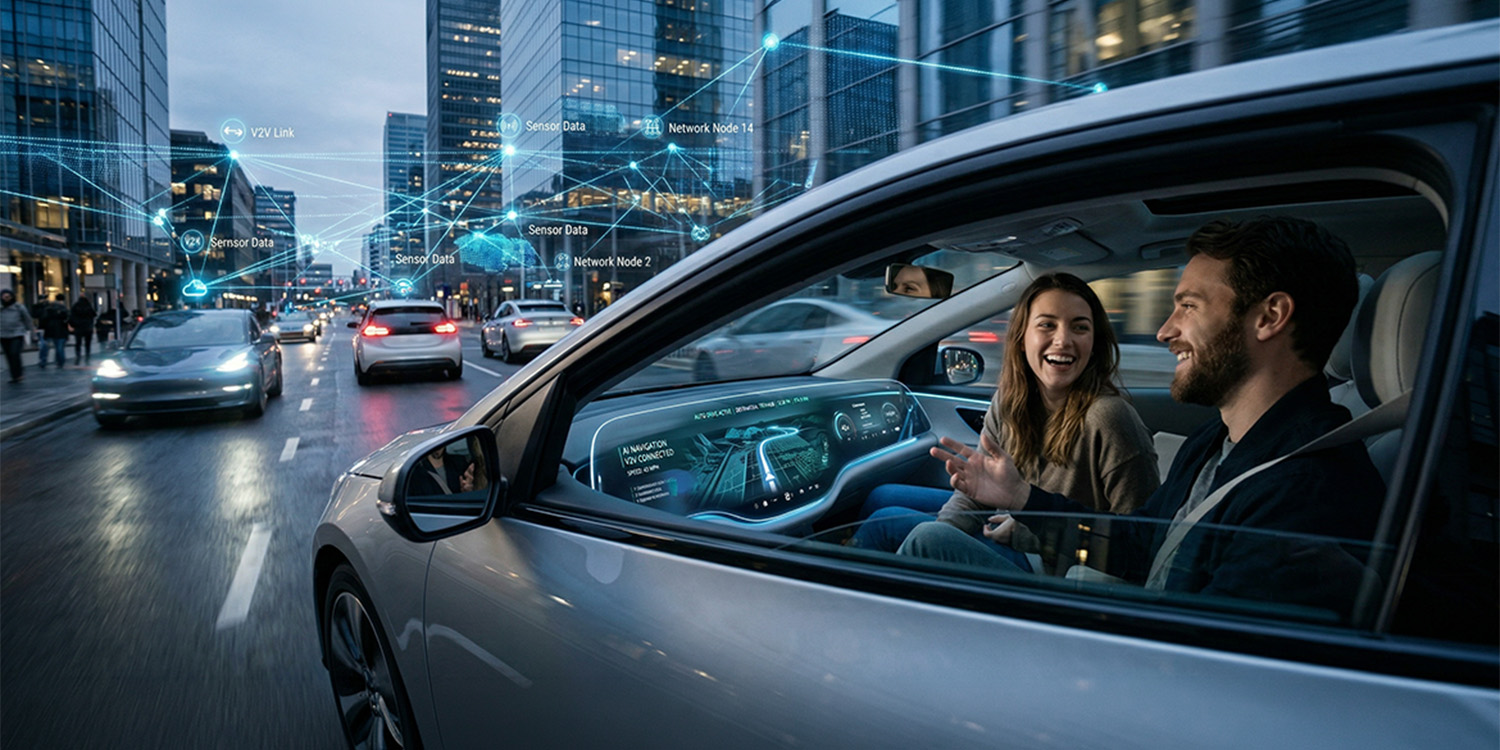
A car’s multiple “senses” are only useful if a central brain can make sense of them all. This process is called sensor fusion. Your brain instinctively combines information from your eyes, inner ears, and the feeling in your feet to keep your balance. The car’s computer does the same, blending camera, radar, and LiDAR data into a single, coherent picture of the world to avoid getting confused by conflicting signals.
Once it has this clear picture, the car’s brain must decide what to do. Rather than being programmed with rigid “if-then” rules, it uses Machine Learning, a type of AI. By analyzing enormous volumes of driving data—billions of miles from real roads and simulations—the system teaches itself to recognize patterns and anticipate what might happen next, much like a person learns from experience.
This AI brain uses the fused data to make predictive judgments. It’s not just about identifying a cyclist ahead; it’s about anticipating that they might suddenly swerve to avoid a pothole. This ability to understand context is what separates a smart car from a simple machine.
The debate over the best way to build a car’s brain has split the industry into two camps, each championed by a tech giant pursuing a dramatically different path.
On one side are companies like Waymo (from Google) and Cruise (backed by General Motors). They use a full suite of sensors, relying heavily on LiDAR. For them, LiDAR’s precise 3D map is a non-negotiable safety net, providing superhuman perception in all conditions. Their approach prioritizes maximum reliability from day one for autonomous vehicles, even if the hardware is more expensive and complex.
In the other corner is Tesla, which famously removed LiDAR from its vehicles. Its “vision-only” strategy bets that with a powerful enough AI, cameras alone are sufficient—after all, humans drive using only their eyes. This makes the system far cheaper and easier to install on millions of cars, but it places an immense burden on the AI to interpret the world perfectly.
With other major players like Apple also quietly working on their own secret projects, the race is on to see which philosophy will ultimately prove superior and solve the final, toughest challenges of real-world driving.
While today’s self-driving systems can master predictable highways, their greatest test lies in the unexpected “edge case.” A sudden blizzard that covers road markings, a construction worker waving a flag, or a flock of geese crossing the road are all rare events that can confuse an AI. Teaching a car to handle the bizarre 1% of driving situations is vastly more difficult than programming for the predictable 99%.
Beyond these technical puzzles lie profound ethical dilemmas. If an accident is truly unavoidable, who does the car protect? Should it swerve to avoid a jaywalker, potentially harming its passenger? Engineers must now program moral logic into a machine, turning a philosophical question into a line of code with life-or-death consequences.
The final hurdles aren’t just technological. The creation of clear autonomous vehicle safety regulations and earning public trust are equally critical. Even a perfect system is useless if people are afraid to use it, which is why public perception of driverless cars remains a key focus. But in a few select cities, companies are already working to earn that trust, one ride at a time.
So, when will a fully driverless car be in your garage? Probably not next year. The most immediate impact of autonomous cars on society is happening through robotaxi services. In cities like Phoenix and San Francisco, this new business model is already a reality, focusing on public mobility over private ownership.
The future of driverless cars is arriving in two separate lanes: the shared robotaxi is the revolution of today, while the car in your own driveway remains the evolution of tomorrow.


Comments are closed